

Based on the report provided by the National Investment Center for Seniors Housing & Care (NIC), it has been established that assisted living facilities in the US have managed to achieve an occupancy rate of 87.7% until the end of 2025.

Given this scenario, there is no denying the fact that the market demand is rising for quality senior housing options. In view of this scenario, one needs to know what to look for during an assisted living tour to make the right choice.
The following is an assisted living facility tour checklist to help you compare and keep a list of things to observe.
Why Touring an Assisted Living Facility Is an Important Step
A senior living facility tour is a necessary part of the process as it allows families to witness in person the environment, staff, and care level afforded to residents.
During the tour, you can inspect the cleanliness of the facility, check if the safety precautions are up to standard, explore the meal choices, find out which entertainment activities are available, and assess the general ambiance.
At the same time, you get a chance to learn about the availability of medical services, how individual care is administered, and even the financial aspects.
A physical presence in the facility will give you much more confidence and a thorough understanding so you don’t make a decision only based on some advertisement or word of mouth that might be false.
Questions About Caregiver Qualifications and Staff Availability
In order to assess the quality of the care team, you should ask for details on their credentials, certificates, and senior care experience. Enquire whether new staff members are being trained and what the average number of caregivers available is during daytime, night, weekend, and Holiday hours besides regular work shifts.
You may also benefit from getting answers to questions related to staff residency ratio, employee attrition, and whether the same caregivers consistently help the residents. Such information can make you more confident about the standard of care and its continuity.
Questions About Medical Care and Emergency Response
Find out medical services available on-site and how healthcare needs of residents are handled. Also inquire about the availability of licensed nurses, how medications are handled, and how the facility works together with the physician.
Also find out whether or not the facility has an emergency procedures plan, like the response of the staff to an accident, a medical emergency, or any other urgent situation. Awareness of these procedures will help you guarantee that your family member gets proper treatment in a timely manner when they need medical care.
Questions About Rooms, Amenities, and Safety Features
Request to check out different room types and ask what is covered in each. Find out about housekeeping, laundry availability, online access, means to reach the place, and public spaces.
One should also ask about safety things that an older person may have, like emergency call buttons, handrails, places that can accommodate wheelchairs, secured entrances, and ways to prevent fire and other disasters.
Questions About Meals, Activities, and Daily Routine
It is necessary for you to find out how food is prepared, if it will be feasible to cater to all the dietary requirements, and if the residents have some flexibility with regard to their timing of meals.
Moreover, you must find out about all the recreation activities, classes, and get-togethers which give the residents chances to interact socially, leading to an active and fulfilling life. It is a good idea for you to understand the daily routine of the facility in order to learn about how it leads to an active lifestyle for the residents.
Questions About Costs, Contracts, and Additional Charges
Ask the facility to give a full account of every expense they have to consider. It could be monthly fees and other related costs that are covered in the standard package. You may need to inquire further about additional charges like medication management, specialized care, transportation, or personal assistance services.
Go over the contract terms with keen attentiveness and have a thorough understanding of payments, extra charges, notice requirements, and fee hike provisions. If families are armed with a clear financial picture before signing, they can be the first to prevent unforeseen billings or make a good choice for their elderly members’ assistance.
What to Observe Beyond Asking Questions During the Tour
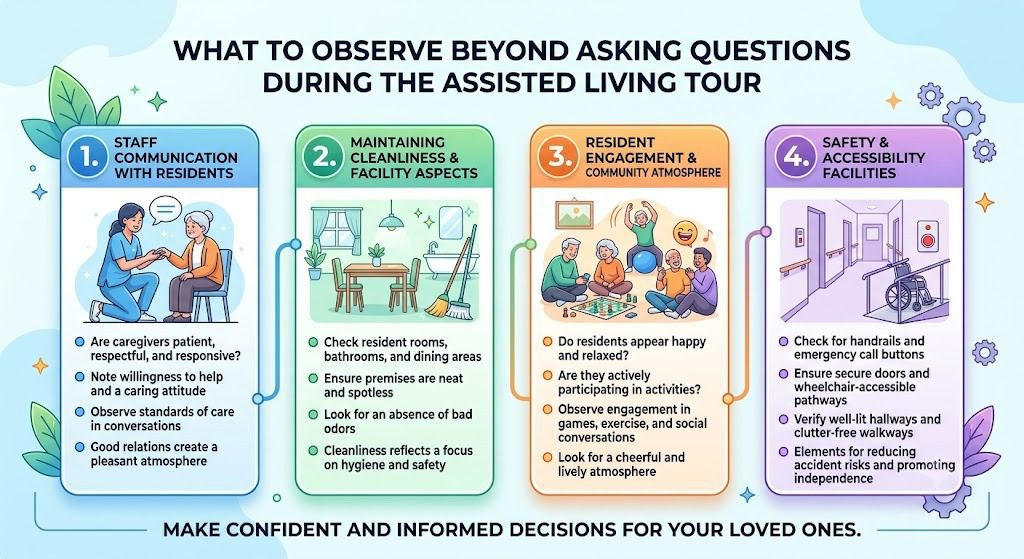
Here are key things to observe in an assisted living facility tour checklist during your facility tour:
1. Staff Communication with Residents
Observe how the nurses or other caregivers conduct their conversations with the residents during the entire duration of the visit and note it on your assisted living visit checklist. This will tell you a great deal about the standard of the care being provided depending on whether the caregivers are being patient, respectful, and responsive to the individual’s needs.
Good conversations, a willing-to-help attitude, and a caring attitude reflect the standard of the care that the elderly people receive. Good relations between workers and residents are often good signs that the place has a great and pleasant residential atmosphere.
2. Maintaining Cleanliness and Other Aspects around Facility
Check if resident rooms, bathrooms, dining areas, and recreational spaces are neat and spotless. It is important that there are no bad odors from the premises and they must look clean and neat.
Cleanliness is one of the most significant factors that will help to keep the residents healthy and also demonstrate their care about hygiene and safety.
3. Resident Engagement and Community Atmosphere
Think about the appearance of the residents whenever you come across them. Are they happy, relaxed, and actively participating in the activities that they are involved in?
In addition to this, it is more noticeable if the residents are engaged in games, exercise with others, and social conversations. An atmosphere that’s cheerful and lively indicates that the housemates regularly and naturally socialize, care for their health, and have fun while living together.
4. Safety and Accessibility Facilities
Walk around the facility and see if safety devices are in place. They may be handrails, emergency call buttons, secure doors, wheelchair-accessible pathways, and well-lit hallways. Determine if walkways are in good condition, free from clutter, and easy to cross.
These are some of the elements reducing accident risks. They also give peace of mind to both residents and care workers about being able to go anywhere and be anywhere independently to a large extent.
These observations can help you in choosing an assisted living facility with more confident and informed decisions.
How Redle Care Welcomes Families for Transparent Facility Tours
At Redle Care, we invite families to come for a tour and take the time to get a full picture of life here as they make their final choice.
They are free to meet with caregivers, take a look at the rooms for residents, find out the types of care offered, and, more importantly, ask any questions they may have without the pressure of having to make an immediate decision.
Our open manner of working is intended to assist families by giving them a good idea of what the care community is all about, the standard of care, and the assurance that their loved one is going to be looked after with the utmost care and in a safe and warm atmosphere waiting for them.
Conclusion
The selection of a suitable assisted living community for senior citizens includes much more than the mere act of comparing brochures or online reviews. A tour of the community, asking relevant questions, and making careful observations will surely help a lot in reaching a logical and well-informed decision for a family. It is wise to have an assisted living facility tour checklist for the objective evaluation of each prospective community to see if it is suitable in meeting the needs of the elderly individual in question. A thorough visit today will surely give you peace of mind in the future.
FAQs
1. What questions should I ask during an assisted living facility tour?
Ask about caregiver training and qualifications, availability of medical services, staff-to-resident ratio and on-call staff, safety procedures, food services, social and entertainment activities, charges and payment terms, contract details, insurance and emergency handling procedures.
2. What should I look for when visiting an assisted living community?
Note the cleanliness level, the happiness of the resident, staff interactions with the resident, safety provisions, state of the rooms, accessibility issues, and food areas, as well as the entire atmosphere during the tour.
3. How can I compare assisted living facilities during a tour?
Prepare a checklist of criteria like care services provided, available facilities, service charges and payment methods, staff level (numbers and experience), residents’ social involvement, level and type of safety provided, maintenance of the place, and contract provisions. So that you can use them as your assisted living facility tour checklist tools while visiting different facilities.
4. Why is an assisted living facility tour important?
By visiting, you will get the opportunity to assess the overall health, meet the care providers, have a close look at the facilities, ask any questions that you may have, and finally have a peaceful mind in choosing the right place for care for your elderly member.
5. How do I know if an assisted living community is the right choice for my parents?
A parent with physical and mental limitations is best cared for by a facility that offers customized service plans for their unique needs, meets all their comfort requirements, keeps a good staff-to-resident ratio for ensuring quality attention to residents, is budget-friendly, secure, and ultimately where the care personnel are genuinely nice and supportive.